

At a glance · time value of money
Follow INR 10,000 across a fictional two-year timeline, reverse the calculation with discounting, and check PV and FV formulas in a spreadsheet.
Time value of money connects an amount at one date with an equivalent amount at another using a specified rate and timing convention. Compounding moves a present amount forward; discounting moves a future amount back. A calculation is meaningful only when the cash-flow dates, rate and period count agree. Start with a timeline before choosing the formula.
Present value and future value formulas
| Question | Formula | Inputs |
|---|---|---|
| What does an amount become? | FV = PV x (1 + r)^n | PV: present value; r: rate per period; n: periods |
| What is a future amount equivalent to today? | PV = FV / (1 + r)^n | FV: future value; rate and period count must agree |
The rate can represent an assumed compounding rate or a discount rate appropriate to the question. It is not automatically a deposit rate, inflation rate or forecast return. Discounting a risky receipt does not guarantee payment. The 8% below is a fictional learning input; fees and taxes are excluded.
A checked two-year example
Suppose INR 10,000 compounds annually at 8% for two complete years with no additional contributions or withdrawals. After year one it becomes 10,000 x 1.08 = INR 10,800. The second year applies 8% to that new amount: 10,800 x 1.08 = INR 11,664.
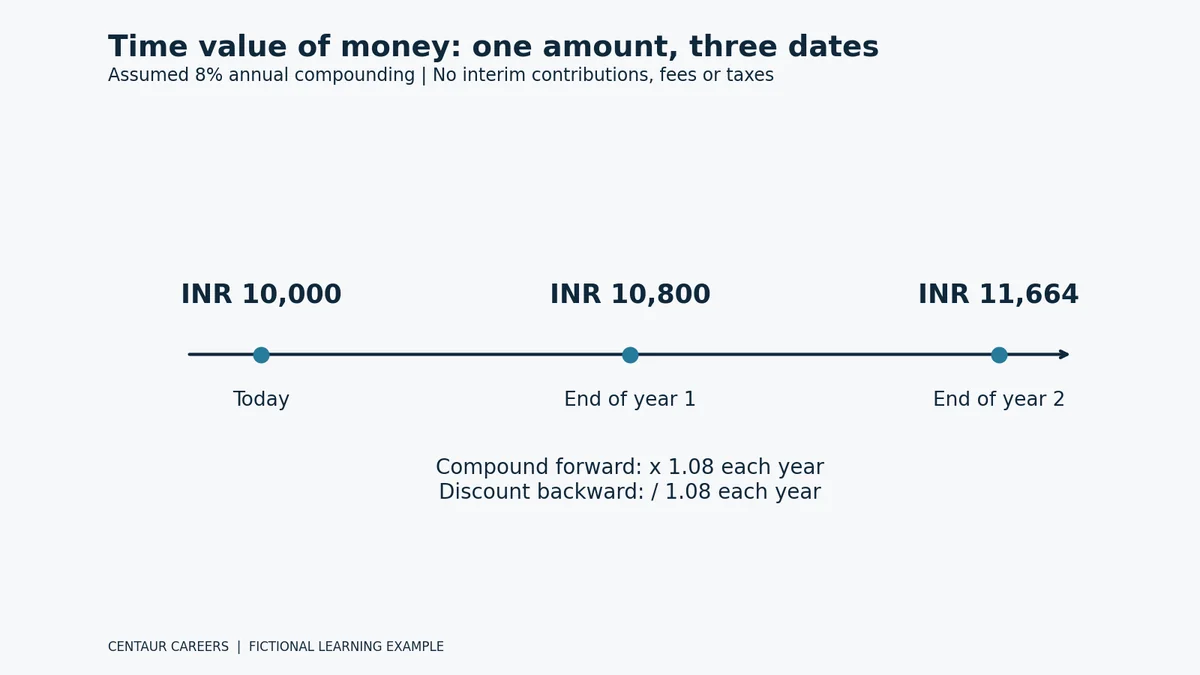
The combined formula is 10,000 x 1.08^2 = INR 11,664. Total growth is INR 1,664. Simple interest on the original INR 10,000 would add INR 800 each year, totalling INR 1,600. The extra INR 64 in this compound example is the second year's 8% applied to the first year's INR 800 growth.
Discount the future amount back to today
Using the same dates and rate, PV = 11,664 / 1.08^2 = INR 10,000. Reversing the calculation is a useful control. If it does not match, check rates, dates, exponents and rounding. Discounting INR 10,000 due in two years instead gives about INR 8,573.39 today: that question uses a different future amount.
| Question | Calculation | INR answer |
|---|---|---|
| FV of 10,000 today after two years | 10,000 x 1.08^2 | 11,664.00 |
| PV of 11,664 due in two years | 11,664 / 1.08^2 | 10,000.00 |
| PV of 10,000 due in two years | 10,000 / 1.08^2 | 8,573.39 |
Excel PV and FV checks
- =FV(8%,2,0,-10000) returns 11,664 for the forward example.
- =PV(8%,2,0,-11664) returns 10,000 for the reverse check.
- The periodic-payment input is zero because there is only one lump sum.
- Amounts paid and received have opposite signs under the cash-flow convention. State the perspective rather than removing a minus sign to make an output positive.
Microsoft documents the functions and the need to align rate and period units. Label the rate interval in the workbook. Keep unrounded figures in calculations and round the displayed answer rather than rounding each factor. The formulas here are checked numerically; no downloadable Excel workbook is represented as tested.
Annual and monthly rates differ
A nominal annual rate of 8% compounded monthly uses 0.08 / 12 per month and 24 periods over two years. The result is 10,000 x (1 + 0.08/12)^24, about INR 11,728.88. An effective annual rate of 8% instead implies a monthly rate of (1.08)^(1/12) - 1, about 0.6434%. Using that equivalent monthly rate over 24 months reproduces INR 11,664.
Nominal and real purchasing-power questions
A nominal amount is expressed in money units at its date. A real comparison adjusts for an explicit price-level assumption. With a fictional nominal annual return of 8% and assumed inflation of 5%, the implied real rate is 1.08 / 1.05 - 1, about 2.86%. Subtracting the rates gives an approximation. Neither input here is a current market rate or inflation forecast.
Practice task and common checks
Change the original annual rate to 6% and retain INR 10,000 for two years. Future value becomes INR 11,236. Discount that amount by 1.06^2 to recover INR 10,000. Then explain why discounting it at 8% answers a different question. The exercise tests timing and assumptions; it does not recommend a financial product.
- Draw dated cash flows first.
- Distinguish a lump sum from recurring payments.
- Match the rate interval and period count.
- Retain assumptions and apply a reverse calculation.
Apply discounting to a capital-budgeting example
See how a DCF uses future cash flows
Sources and scope
CFA Institute places time value of money within the foundation for valuing dated financial cash flows. Microsoft Support provides the function syntax. The timeline, amounts and practice questions above are original. Actual decisions require appropriate rates, risks, contractual timing, fees and tax treatment.
CFA Institute: time value of money in finance
Microsoft Support: PV function
Microsoft Support: FV function
Does compounding guarantee growth?
No. It calculates a result under supplied assumptions. Actual returns, costs and payment risk require separate evidence.