
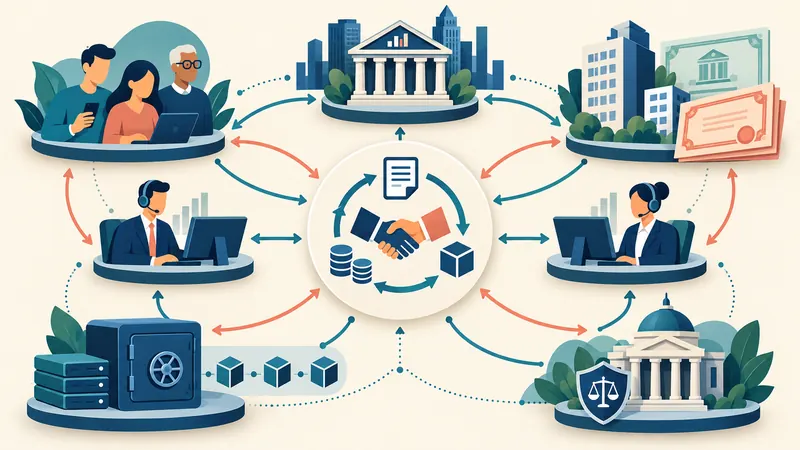
A financial market is a setting and set of arrangements through which participants issue, buy, sell or transfer financial claims and instruments. Common financial instruments include equity, debt, money-market products and derivatives; market participants can include investors, issuers, intermediaries and infrastructure providers. The term covers different markets, institutions, products and rules; there is no single workflow that applies to every transaction. This guide introduces broad categories and focuses on operational handoffs. It is educational, not a recommendation to trade or invest.
Common instrument and market categories
- Equity securities represent ownership interests under their terms and applicable law.
- Debt instruments represent borrowing arrangements with terms such as principal, interest, maturity and repayment conditions.
- Money-market instruments generally relate to shorter-term borrowing or liquidity needs; product design and eligibility vary.
- Derivatives derive value from an underlying reference or agreed terms and can involve complex risks; a name alone does not explain suitability.
- Primary-market activity concerns issuance of new securities, while secondary-market activity concerns transactions in existing securities. The boundary and process details depend on the product and venue.
Participants may include issuers, investors, brokers or other intermediaries, trading venues, clearing entities, depositories, custodians, banks and regulators. Which parties take part depends on the instrument and market structure. A participant's presence in a diagram does not imply endorsement, guarantee or suitability of a product.
Financial market, instrument, institution, and product
These four terms are often mixed together. A market is the arrangement in which eligible participants issue or transact. An instrument is the financial claim or contract being issued, held, or transferred. An institution or intermediary performs a defined role in access, execution, clearing, settlement, custody, financing, record keeping, or regulation. A product is the documented offer made available under particular terms. Separating the terms helps a learner read a workflow without assuming that an exchange, broker, bank, fund, and security are the same kind of thing.
- Equity, debt, money-market instruments, and derivatives describe broad instrument families, not one level of risk or one operating process.
- Primary and secondary describe where issuance or later transactions occur; they do not describe whether an instrument is suitable for a reader.
- Exchange-traded and over-the-counter arrangements can use different venues, participants, documentation, confirmation, clearing, and settlement processes.
- A market index is a measurement construct under its methodology; it is not itself the same as every product that may reference it.
- A bank, broker, custodian, fund, exchange, clearing corporation, depository, and regulator have different responsibilities even when one transaction connects them.
Primary and secondary market activity
In a primary-market transaction, a security is issued under the applicable offer and process, and funds generally move toward the issuer or offering arrangement. In secondary-market activity, existing securities are transacted between eligible parties through the relevant market structure. The distinction affects the documents, parties, records, and operational hand-offs. It does not remove the need to check the specific product and current official information.
Operations around issuance can involve applications, allocations, payment records, security creation, listings, registrar activity, and investor communication. Secondary-market operations can involve orders, executions, allocations, confirmations, clearing, settlement, custody, positions, cash, and later asset servicing. A role may support only one step, so candidates should avoid describing the entire market lifecycle as their personal responsibility.
See how an IPO moves from application to allotment and listing
What different market participants contribute
- Issuers raise funds or create instruments under the applicable corporate, contractual, and regulatory process.
- Investors or authorised decision-makers evaluate opportunities under their own objectives, constraints, mandate, and risk process.
- Intermediaries provide defined access, execution, issuance, custody, record, service, or advisory functions according to their authorisation.
- Market infrastructure institutions support trading, clearing, settlement, and securities records within their respective frameworks.
- Banks and payment systems can support cash, funding, account, and settlement movements depending on the transaction structure.
- Regulators and other authorities set or enforce applicable requirements but do not replace each participant's operating responsibility.
Map financial market intermediaries and their hand-offs
A high-level transaction lifecycle
- An investor or authorised participant makes a decision under its own mandate and places an instruction through an applicable channel.
- A broker or venue processes the order according to its rules; execution, allocation and confirmation details are captured.
- Relevant parties compare transaction details and resolve mismatches through approved procedures.
- Clearing and settlement arrangements coordinate the obligations and transfer of cash and securities under applicable market rules.
- Custody records, cash records and transaction data are reconciled; breaks are investigated, documented and escalated.
This is a simplified teaching map. Actual steps, timing, responsibilities and risk controls vary by product, exchange, clearing arrangement, account, participant and current regulation. Operations teams support accurate records and controlled handoffs; they do not convert a process diagram into investment advice. For India-specific securities-market education, consult current material from SEBI, the exchanges and recognised institutions.
Records created across a securities transaction
One economic event can produce several records because each participant has a different responsibility. An order captures an instruction, an execution record captures matched terms, a confirmation communicates or affirms trade details, a settlement instruction tells the relevant parties how obligations should move, and cash or custody records show resulting balances or positions. These records should connect, but they do not have to look identical or arrive at the same time.
- Instrument and transaction identifiers help connect the same event across systems.
- Quantity, price, currency, account, counterparty, trade date, and settlement date are common comparison fields.
- Status fields show whether an item is captured, matched, instructed, pending, failed, settled, cancelled, or otherwise classified by that system.
- Cash and position records show downstream financial effects and may require separate reconciliations.
- Source, version, timestamp, user or system action, approval, and case notes form part of the evidence trail.
Where market operations exceptions occur
Exceptions can appear when required information is absent, two records use different values, a deadline passes, an instruction is rejected, cash or securities are unavailable, a system file is late, or a later event changes the expected outcome. The label failed trade describes a status or outcome under the applicable process; it does not identify the cause by itself. Investigation should follow the records and authority chain rather than start with blame.
- Confirm that the records describe the same transaction, account, instrument, quantity, currency, and relevant dates.
- Identify the first stage or source at which the values or statuses diverge.
- Check amendments, allocations, cancellations, cut-offs, market calendars, and the latest authorised version.
- Record the operational or customer impact, deadline, materiality, owner, and evidence still required.
- Escalate through the approved route and verify the final cash, position, status, and reconciliation after action.
Learn how reconciliation investigates unmatched records
Financial market operations roles
Roles connected with market workflows can include trade support, confirmations, settlements, reconciliations, custody operations, corporate actions, fund operations, reference data, client operations, reporting, controls, and technology support. The same title can describe different products, markets, shifts, and authority levels. Read the outputs and verbs in the job description instead of assuming that every investment-banking title means front-office deal work.
- Trade support checks economic details, status, allocations, and exceptions around captured transactions.
- Settlements teams monitor instructions, obligations, cut-offs, failures, and resulting cash or securities movement.
- Reconciliation teams compare internal and external records and maintain ownership and evidence for breaks.
- Corporate-actions teams process issuer events, dates, entitlements, elections, and resulting records.
- Fund or custody operations support holdings, cash, valuations, servicing, and controlled reporting under the relevant mandate.
- Control and reporting teams monitor indicators, ageing, evidence, escalation, and recurring process weaknesses.
Explore investment banking operations careers
A safe practice exercise
Create a fictional trade record, confirmation, settlement-status file, cash record, and position record for ten invented transactions. Add one quantity mismatch, one late status, one duplicate, and one timing difference. Define the matching fields, identify the first differing record, and write an exception note with evidence, owner, deadline, and closure test. The exercise demonstrates market-operations reasoning without making an investment decision or exposing confidential data.
How the topic relates to Centaur Careers
Financial markets provide context for trade settlements, reconciliation, corporate actions, and fund accounting within the Investment Banking Operations module of Centaur Careers' Financial Operations Masterclass. This article does not create a financial-markets trading class or provide investment advice. Use the canonical program page to review the published curriculum and confirm current cohort details and terms.
Explore the Investment Banking Operations module
What is a financial market?
It is a set of arrangements through which eligible participants issue, buy, sell, or transfer financial instruments or claims under applicable rules and contracts. Different markets use different products, institutions, and workflows.
What are common financial instruments?
Broad categories include equity, debt, money-market instruments, and derivatives. A category name does not explain the complete terms, risk, liquidity, suitability, or operating process of a specific instrument.
What is the difference between primary and secondary markets?
Primary-market activity concerns the issuance of new securities, while secondary-market activity concerns transactions in existing securities. The parties, documents, records, and operating steps differ by product and market structure.
Does this guide provide investment advice?
No. It explains market structure and operations for educational purposes. Real investment decisions require current official information and, where appropriate, authorised professional advice.
Questions to ask when learning a market workflow
- Who is authorised to make the decision, submit the instruction and approve an exception?
- Which records are authoritative, and how are they matched across parties?
- What is the settlement arrangement and which deadlines or market calendars apply?
- How are unmatched, late or incomplete items recorded, owned and escalated?
- Which official source explains the product, participant role and current rules?
Follow a trade lifecycle and related career skills
Read SEBI investor education on securities
Explore NSE investor education
Centaur Careers publishes this general market-structure explainer. It does not offer investment recommendations, describe a complete legal rulebook or claim that every market topic is in the current Financial Operations Masterclass. Verify current product information and regulations with official sources.