

At a glance · cost of capital formula
Calculate a fictional 11.1% WACC, trace each input, and test how equity costs, tax assumptions and weighting choices affect the result.
For a simplified business financed by ordinary equity and debt, the cost of capital formula is WACC = (E / V x Ke) + (D / V x Kd x (1 - T)), where V = E + D. It combines the required equity return with a conditional after-tax debt cost. The answer depends on the value weights, estimated rates and tax assumption.
Define every input before calculating WACC
| Symbol | Meaning here | Check |
|---|---|---|
| E | Market value of ordinary equity | Valuation date and share basis |
| D | Market value of interest-bearing debt | Included instruments and any proxy |
| Ke | Required equity return | Not simply the dividend yield |
| Kd | Current pre-tax cost of debt | A historical coupon may not equal the current required return |
| T | Applicable marginal tax assumption for interest benefit | Whether the benefit is available |
| V | E + D | Weights sum to one |
Cost of capital is a financing opportunity cost used for a specified analytical purpose. It is not the same as total cash interest paid. Equity may have a required return without contractual interest. Preference shares, complex debt, changing financing structures or restricted tax benefits need more analysis than this two-source model.
Worked example: an illustrative 11.1% WACC
A fictional company has market-value inputs of INR 600,000 equity and INR 400,000 debt on the assumed valuation date. Assume Ke = 14%, Kd = 9% and T = 25%. The tax rate is an invented input, not a statement of Indian tax law. Assume the relevant interest tax benefit can be fully used on the assumed timing basis. There are no other financing sources.
- V = 600,000 + 400,000 = INR 1,000,000.
- Equity weight = 600,000 / 1,000,000 = 60%.
- Debt weight = 400,000 / 1,000,000 = 40%.
- After-tax debt cost = 9% x (1 - 25%) = 6.75%.
- Equity contribution = 60% x 14% = 8.40 percentage points.
- Debt contribution = 40% x 6.75% = 2.70 percentage points.
- WACC = 8.40% + 2.70% = 11.10%.
The weights total 100%, and WACC lies between the assumed after-tax debt cost of 6.75% and equity cost of 14%. This is a useful arithmetic check for positive weights. It cannot establish whether the original market values, rates or tax treatment were appropriate.
Sensitivity: change one assumption
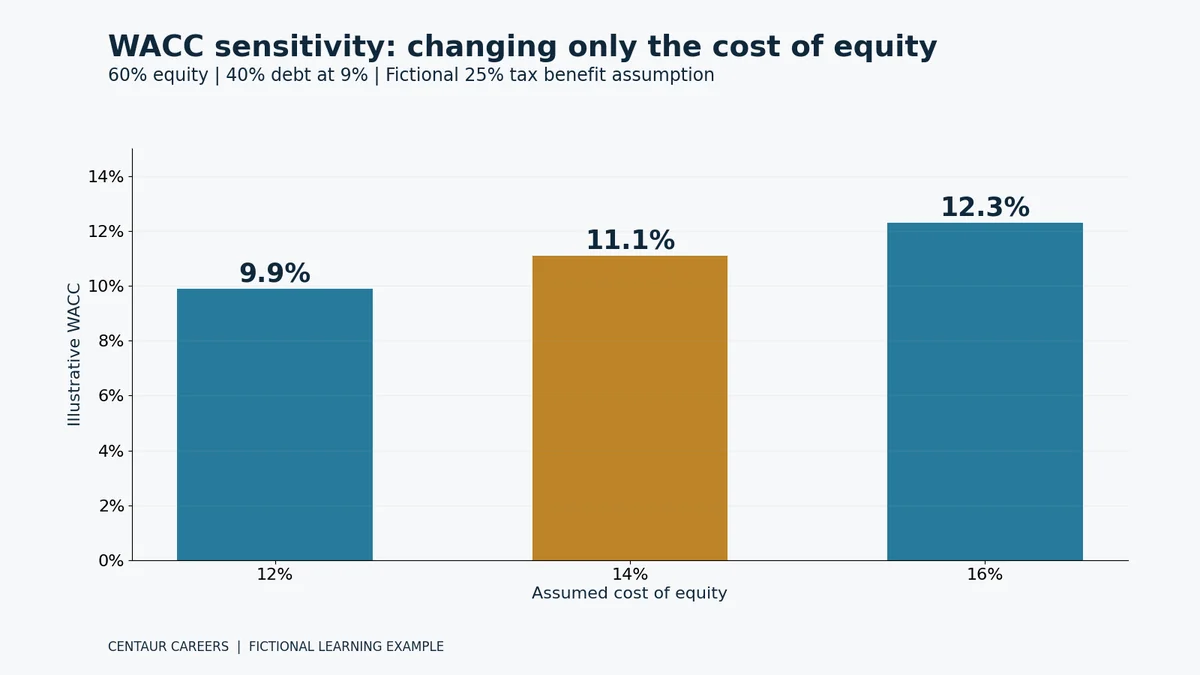
| Scenario | Calculation | WACC |
|---|---|---|
| Equity cost 12% | 0.60 x 12% + 0.40 x 9% x 0.75 | 9.9% |
| Equity cost 14% | 0.60 x 14% + 0.40 x 9% x 0.75 | 11.1% |
| Equity cost 16% | 0.60 x 16% + 0.40 x 9% x 0.75 | 12.3% |
| No interest tax benefit | 0.60 x 14% + 0.40 x 9% | 12.0% |
Why the weighting basis matters
Suppose an analyst substitutes accounting amounts of INR 300,000 equity and INR 400,000 debt, retaining the rates. The resulting weights are about 42.86% and 57.14%, giving approximately 9.86%. That is a different weighting exercise, not a way to reproduce 11.1%. Before substituting an accounting amount for market value, explain the valuation purpose, justification and uncertainty.
Common cost of capital errors
- Entering 14 instead of 14% in a formula expecting decimal rates.
- Applying an assumed debt tax benefit to equity as well.
- Using an old coupon without checking current borrowing cost.
- Mixing a rate in one currency with cash flows in another without a consistent method.
- Increasing debt weights while assuming financing risks and required returns cannot change.
- Selecting a discount rate because it produces a desired valuation.
When a company WACC does not fit a project
A project with different business risk, currency or financing characteristics may need another discount-rate approach. Cash-flow and discount-rate definitions must agree: a company-wide WACC is not automatically appropriate for equity-only cash flows. A real valuation needs defensible risk, timing, tax and financing assumptions. This article supplies no market-calibrated rate for an actual company.
A spreadsheet task with a review trail
Separate values, rates and tax assumptions into an input area. Derive the weights, then multiply each by its corresponding cost. Reproduce the four scenarios while keeping the base case intact. Record the source and date you would need for every real-world input. A reviewer should be able to tell whether a changed result came from market values, rates or tax treatment.
Understand the financing mix before choosing weights
Review a DCF example with an explicit discount-rate assumption
Apply discounting in capital budgeting
Sources and scope
The University of Queensland open text explains WACC and value weights. ACCA discusses capital structure and tax effects. The amounts, rates and sensitivity cases here are original fictional inputs intended to make the calculation reproducible. Real input selection requires current evidence and review.
University of Queensland: cost of capital
ACCA: optimum capital structure
Can I use 11.1% for any company valuation?
No. It follows from the fictional inputs. A real rate requires evidence and consistency with the cash flows being valued.
Is WACC the same as cost of debt?
No. Debt is one component; this model also includes the required return on equity.