

At a glance · difference between cash flow and fund flow
Trace three fictional transactions through cash and net working capital, then reconcile the balances to understand why their movements can differ.
The difference between cash flow and fund flow depends first on what funds means. A cash-flow statement explains changes in cash and cash equivalents. In the traditional fund-flow approach used here, funds means net working capital: current assets minus current liabilities. Cash can move without changing that net amount. Three fictional transactions make the distinction visible.
Cash flow statement vs fund flow statement
| Question | Cash-flow view | Traditional fund-flow view |
|---|---|---|
| Balance tracked | Cash and cash equivalents | Net working capital |
| Movement explained | Cash receipts and payments under the relevant reporting framework | Sources and applications affecting the net current position |
| Supporting work | Cash reconciliation and activity classification | Schedule of changes in current assets and current liabilities |
| Reporting purpose | Follow the applicable reporting standard | Traditional analysis does not replace required cash-flow reporting |
IAS 7 describes IFRS cash-flow reporting through operating, investing and financing activities. The INFLIBNET teaching chapter explains the working-capital interpretation in traditional fund-flow analysis. Actual reporting-framework requirements must be checked for the entity. This limited exercise does not prepare a complete statutory statement.
Fictional opening balances and assumptions
An invented business begins with cash INR 30,000, trade receivables INR 40,000 and inventory INR 20,000. All are current assets, totalling INR 90,000. Current trade payables are INR 25,000 with no other current liabilities. Opening net working capital is INR 65,000. Assume no overdrafts, restricted cash or cash equivalents, and ignore tax, fees and interest during the transactions.
Collect INR 20,000 of an existing receivable
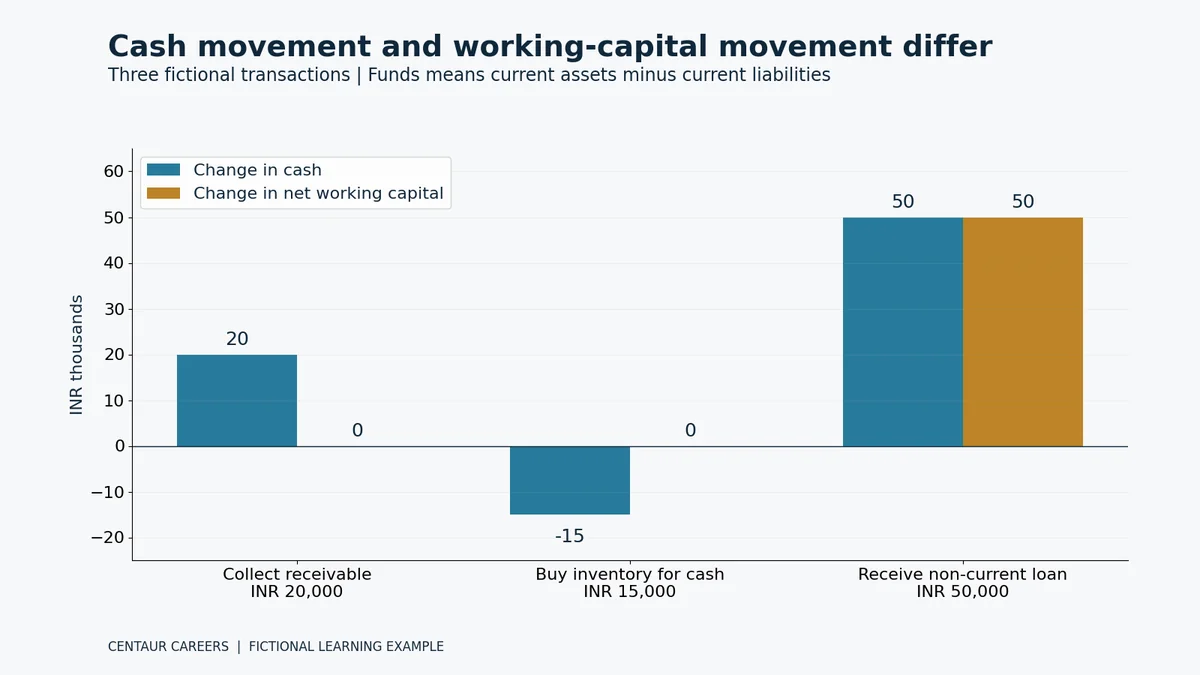
Cash rises to INR 50,000 while receivables fall to INR 20,000. One current asset has been exchanged for another. Total current assets remain INR 90,000 and net working capital remains INR 65,000. Cash inflow is INR 20,000 but the change in the defined funds balance is zero. Collection of an existing invoice is not an additional sale.
Buy inventory for INR 15,000 cash
Cash next falls to INR 35,000 and inventory rises to INR 35,000. Receivables stay at INR 20,000. Current assets still total INR 90,000 and net working capital remains INR 65,000. Cash has moved out but the defined funds balance is unchanged. Assume the inventory qualifies for current-asset treatment and has not yet been sold or expensed.
Receive an INR 50,000 non-current loan
The business then receives INR 50,000 cash under a fictional loan whose entire principal is non-current at the measurement date. Cash becomes INR 85,000. Current assets rise to INR 140,000; current liabilities remain INR 25,000. Net working capital becomes INR 115,000, an increase of INR 50,000. This transaction changes both cash and the net current position.
| Position | Cash | Receivables | Inventory | Current assets | Current liabilities | Net working capital |
|---|---|---|---|---|---|---|
| Opening | 30,000 | 40,000 | 20,000 | 90,000 | 25,000 | 65,000 |
| After collection | 50,000 | 20,000 | 20,000 | 90,000 | 25,000 | 65,000 |
| After inventory purchase | 35,000 | 20,000 | 35,000 | 90,000 | 25,000 | 65,000 |
| After non-current loan | 85,000 | 20,000 | 35,000 | 140,000 | 25,000 | 115,000 |
Reconcile the two movements independently
Cash increased by 85,000 - 30,000 = INR 55,000, explained by +20,000 -15,000 +50,000. Net working capital increased by 115,000 -65,000 = INR 50,000, explained by the non-current loan under the assumptions. The INR 5,000 difference between those changes reflects the net cash effect of exchanging current assets in the first two steps.
What if the loan is current?
Reset to the position after the inventory purchase. If the INR 50,000 receipt creates an entirely current loan liability, current assets and current liabilities both rise by INR 50,000. Cash rises but net working capital does not. Maturity and current/non-current classification therefore cannot be implicit in a fund-flow example.
Common mistakes
- Switching the meaning of funds midway through the analysis.
- Treating collection of an old receivable as new revenue.
- Assuming every borrowing is non-current.
- Treating purchased inventory as an immediate expense without considering the accounting basis.
- Calling a few transactions a complete financial statement.
- Inferring cash availability from a positive net-working-capital balance alone.
Practice: pay a current supplier balance
After the original non-current-loan case, pay INR 10,000 of existing current trade payables. Cash falls to INR 75,000, current assets to INR 130,000 and current liabilities to INR 15,000. Net working capital remains INR 115,000 because a current asset and a current liability both decreased by the same amount. Verify both reconciliations and explain the classification assumptions.
Compare direct and indirect cash-flow presentation
Explore the working-capital operating cycle
Read a balance-sheet format and example
Sources and scope
The sources establish the definitions and reporting context. All balances, transactions and reconciliations above are original fictional material. Use the explicit current/non-current assumptions when reproducing the exercise, then check the applicable reporting framework before analysing a real entity.
IFRS Foundation: IAS 7 Statement of Cash Flows
INFLIBNET: traditional fund-flow meaning and analysis
Can cash rise while net working capital stays unchanged?
Yes. Collecting a current receivable increases cash and reduces receivables by the same amount in this example.
Does fund flow always mean working-capital movement?
No. Define funds explicitly. This article uses the traditional net-working-capital convention.